A Peek Inside a Sample Report
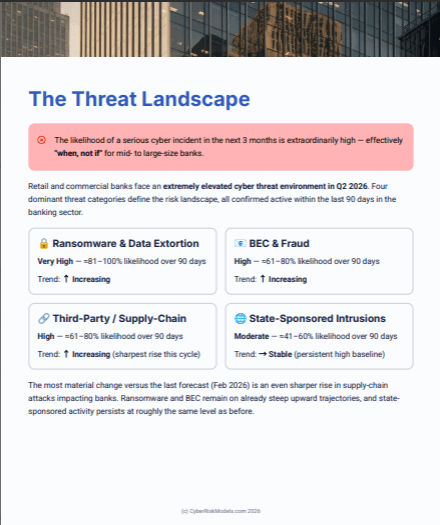
Summary
You'll get an overview of the top risks in your industry, as well as an overview of what's happening in your industry.
This is your go-to for a quick snap-shot of where things stand.
When leadership asks "What's our top risk"? you'll get your answer right here.
Industry signals made relevant to your business.
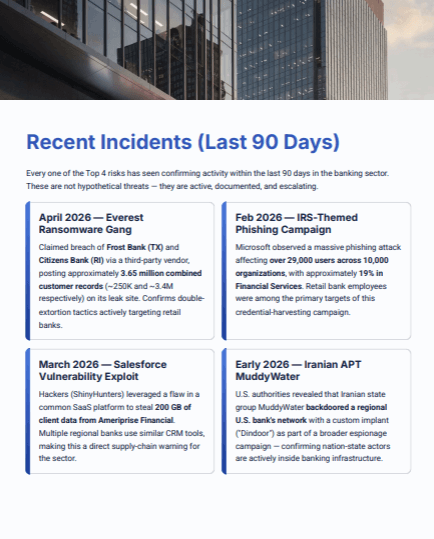
Review of recent events
Every report is grounded in recent events (30-60-90 days). This section gives you a recap of the hundreds of sources and incidents reviewed in that time period. These are the most impactful events, the ones that are shaping what the future expectation will be.
When leadership asks "What changed recently?", this is what you can reference because these are the events driving risk.
Deep insights into what is shaping your risk.
Priority Actions
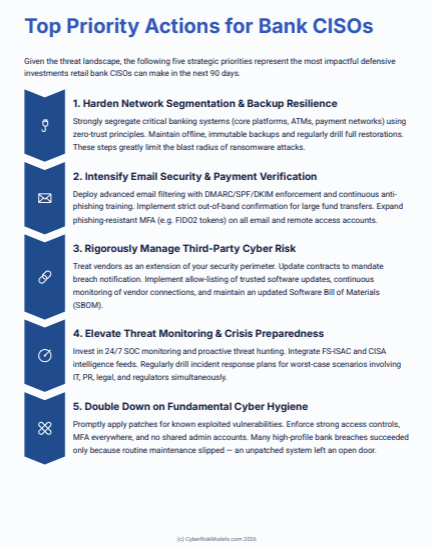
This is where you'll get actionable recommendations for strategy and mitigation. These are based on an analysis of what actually reduces risk, business impact, and blast radius.
So when you get asked "What can we do?", you've got the answer right here. This will drive your conversations around prioritization with limited resources.
Actionable recommendations.
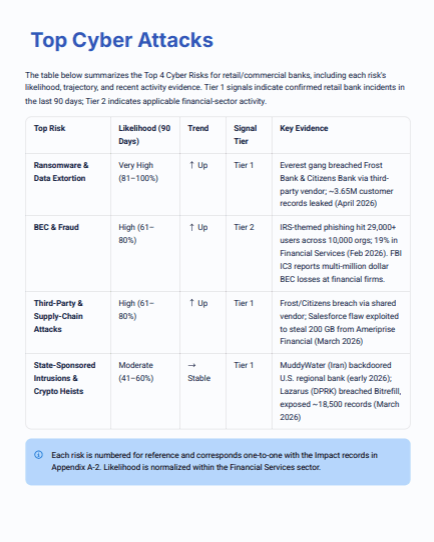
Top Attacks Trending
Every report will give you the top attacks, the likelihood they will occur in the industry based on how they trended in the past 30-60-90 days.
When leadership asks "What should we expect next?", this is where you come for the deep insight as to whether a risk is increasing, decreasing or holding steady.
Insights into attack patterns.
Financial Impact
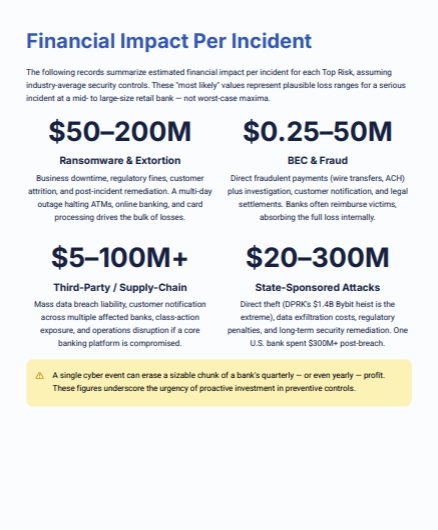
We quantify the impact in financial terms, based on what's been reported actually happening in your industry, in the last 30-60-90 days. These are real organizations, not that different from yours, and the real cost.
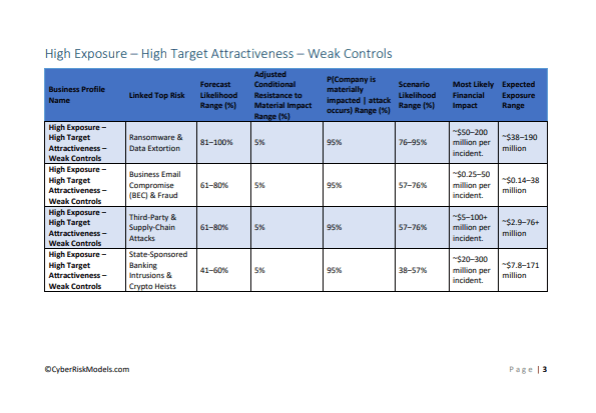
So, when leadership asks "What are the typical costs?" you'll have real numbers to share with them. But we know every business is unique, that's why we give you business profiles that dial these number in for your organization, based on your exposure, how attractive your data is, and the maturity of your security.
Solid numbers based on real data.
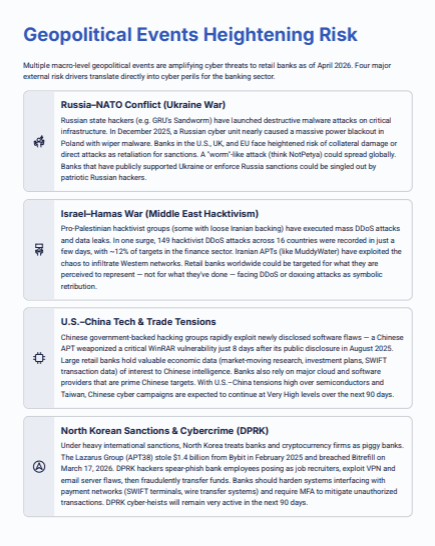
Geopolitical Events
In today's world, geopolitical events are shaping risk across all industries. We give you the highlights, those events that impact your industry, and could impact your organization.
So, when leadership asks "What should we be aware of?" you'll sound like the smartest person in the room because you'll have deep insights into the most likely impact of geopolitical event for your organization (not just the industry).
Understanding beyond the headlines.
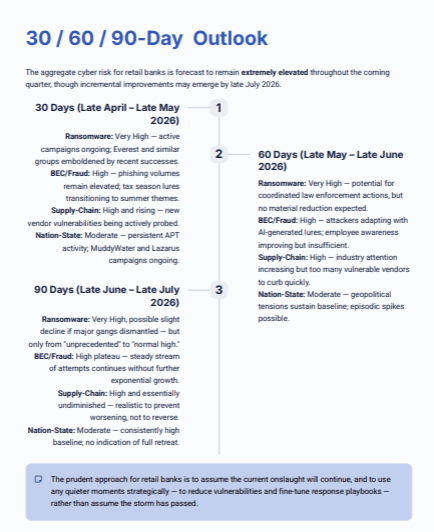
The 30-60-90 Day Outlook
Based on recent events we forecast the most likely categories of attacks over the next 30-60-90 days. When you are discussing strategy, mitigations, or spending this is where you can refer to dial-in expectations.
So, when leadership asks "What should we expect this quarter?", you'll have a ready answer based on real events.
That's a pretty powerful position to be in.
Your Business Profile
There are three characteristics that determine which businesses are more likely to be targeted and attackers to be successful; exposure, how attractive your data is, and how mature your security practices are. We've quantified every combination and give them to you as business profiles. Your business fits one of them.
So when leadership asks "How does that relate to us?" you'll know the likelihood of each attack scenario and expected financial impact specific to your business.
Pick your profile and know you business-level risk.
Controls
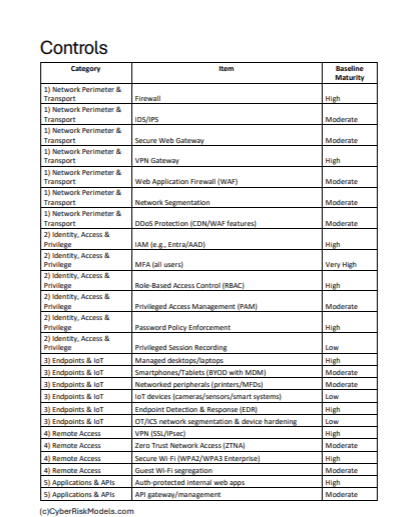
To help you evaluate your security we give you the industry baseline of controls and maturity level. This isn't an assessment, this is just a reference for you when you have discussions around security.
So, when Operations argues that your security is better than the industry average, you'll have the industry average available for comparison. And, when leadership asks "How are we doing?" you'll be able to discuss where you are better, or worse than your peer organizations.
Knowing how you compare the industry baseline is useful in highlighting areas for improvement that move you out of the "likely victim" group by reducing attacker success rates.