Cyber Risk Forecast for Hospitals and Health Systems

$75 / Month Subscription

Get your Business-level risk forecast

for the price of a daily latte.

And the first month's forecast is free. Cancel at any time.

Name

Email

Company Name

We will not send spam

You'll be taken to the payment screen after subscribing here.

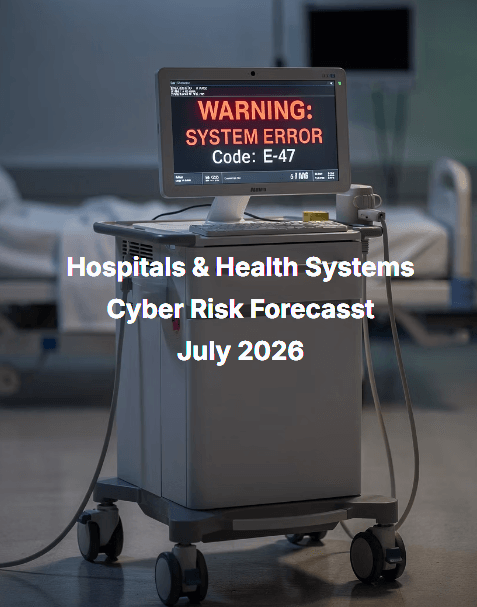
Hospitals & Health Sytems

Cyber Risk Forecast
Monthly Cyber Risk Forecast

Cancel at any time.

Understand how ransomware, system disruption, and patient data exposure translate into operational and financial impact— and how likely your organization is to be impacted

Hospitals and health systems face a threat landscape where cyber incidents directly affect patient care. Ransomware and system outages do not simply disrupt IT—they delay procedures, divert patients, and impact clinical decision-making.

The healthcare sector is a high-value target due to the volume and sensitivity of patient data, as well as the reliance on interconnected systems across care delivery. Attacks are increasing in frequency and often exploit dependencies between systems such as billing, imaging, and electronic health records.

This forecast focuses on how these attack patterns are evolving across the sector. It establishes an industry baseline model and then customizes that based on three critical factors that determine the individual business risk: exposure, how attractive the data is, and maturity of security practices.

Answer 3 questions, and as soon as you select your profile you have cyber risk quantified for your business.

Your Business-Level Risk Forecast

  • Overview of the top risks

  • Priority actions for CISOs on strategy and mitigations for the next 90 days

  • Estimated (typical) financial impact for each risk category

  • Overview of geopolitical events driving risk and how it impacts your industry

  • A 30-60-90 day outlook of how attacks are anticipated to shift

  • Your industry risk quantified: each attach scenario likelihood and corresponding financial impact estimate (industry 'typical' profile)

  • Your business-level risk quantified: customized profiles that quantify your organization's risk based on the three primary characteristics that determine your likelihood of being targeted for attack, the success factor, and reasonably expected financial impact.

  • Control maturity matrix so you see how you compare to the industry baseline

For leadership, the challenge is balancing regulatory compliance with actual resilience. This forecast provides visibility into which risks are most likely to disrupt care delivery and which controls have demonstrated impact in reducing those outcomes.
A Peek Inside a Sample Report

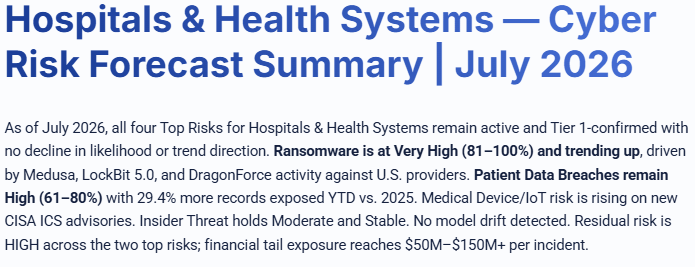
Summary

You'll get an overview of the top risks in your industry, as well as an overview of what's happening in your industry.

This is your go-to for a quick snap-shot of where things stand.

When leadership asks "What's our top risk"? you'll get your answer right here.

Industry signals made relevant to your business.

Review of recent events

Every report is grounded in recent events (30-60-90 days). This section gives you a recap of the hundreds of sources and incidents reviewed in that time period. These are the most impactful events, the ones that are shaping what the future expectation will be.

When leadership asks "What changed recently?", this is what you can reference because these are the events driving risk.

Deep insights into what is shaping your risk.

Priority Actions

This is where you'll get actionable recommendations for strategy and mitigation. These are based on an analysis of what actually reduces risk, business impact, and blast radius.

So when you get asked "What can we do?", you've got the answer right here. This will drive your conversations around prioritization with limited resources.

Actionable recommendations.

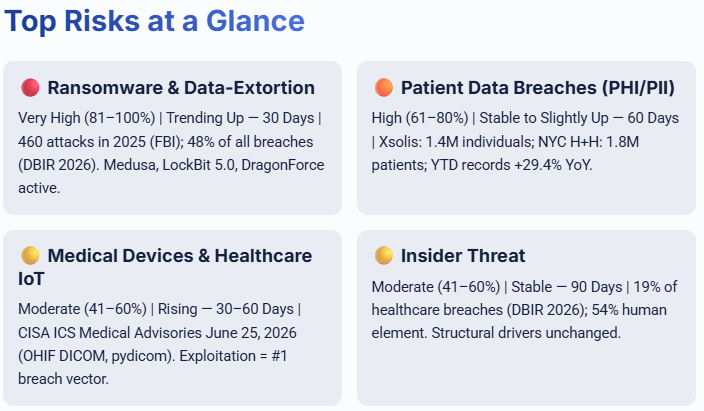
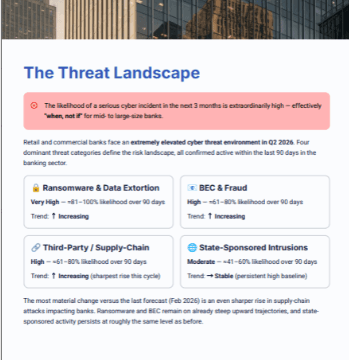
Top Attacks Trending

Every report will give you the top attacks, the likelihood they will occur in the industry based on how they trended in the past 30-60-90 days.

When leadership asks "What should we expect next?", this is where you come for the deep insight as to whether a risk is increasing, decreasing or holding steady.

Insights into attack patterns.

Financial Impact

We quantify the impact in financial terms, based on what's been reported actually happening in your industry, in the last 30-60-90 days. These are real organizations, not that different from yours, and the real cost.

So, when leadership asks "What are the typical costs?" you'll have real numbers to share with them. But we know every business is unique, that's why we give you business profiles that dial these number in for your organization, based on your exposure, how attractive your data is, and the maturity of your security.

Solid numbers based on real data.

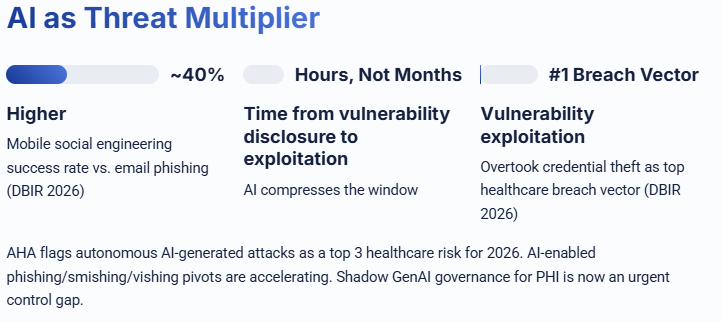
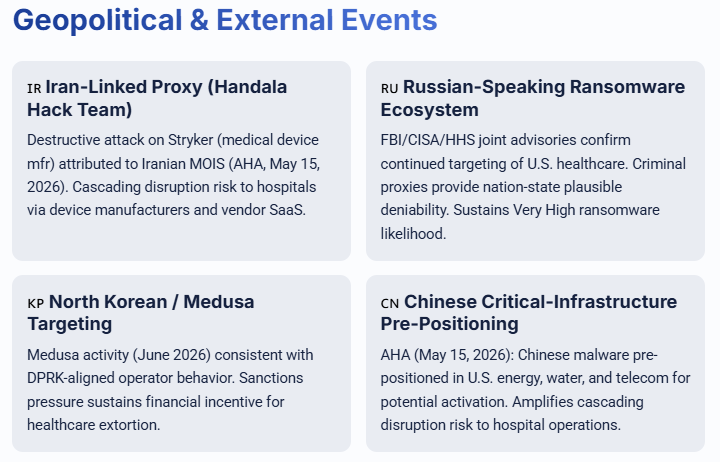
Geopolitical Events

In today's world, geopolitical events are shaping risk across all industries. We give you the highlights, those events that impact your industry, and could impact your organization.

So, when leadership asks "What should we be aware of?" you'll sound like the smartest person in the room because you'll have deep insights into the most likely impact of geopolitical event for your organization (not just the industry).

Understanding beyond the headlines.

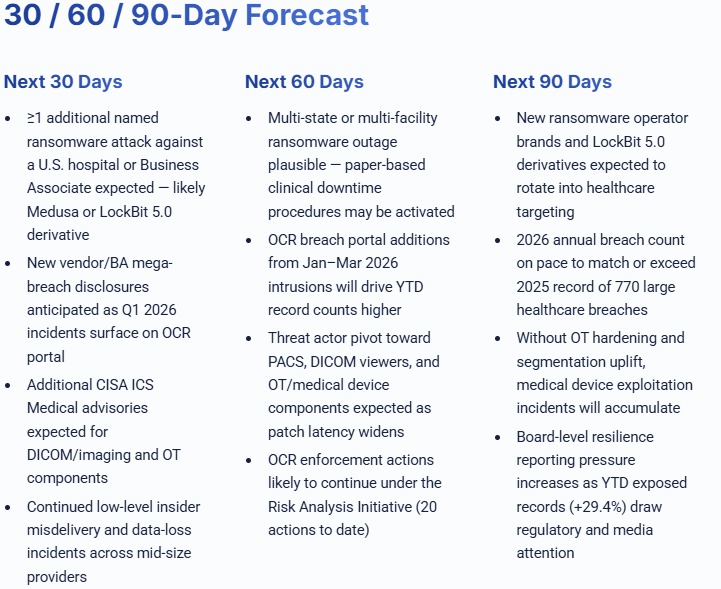
The 30-60-90 Day Outlook

Based on recent events we forecast the most likely categories of attacks over the next 30-60-90 days. When you are discussing strategy, mitigations, or spending this is where you can refer to dial-in expectations.

So, when leadership asks "What should we expect this quarter?", you'll have a ready answer based on real events.

That's a pretty powerful position to be in.

Your Business Profile

There are three characteristics that determine which businesses are more likely to be targeted and attackers to be successful; exposure, how attractive your data is, and how mature your security practices are. We've quantified every combination and give them to you as business profiles. Your business fits one of them.

So when leadership asks "How does that relate to us?" you'll know the likelihood of each attack scenario and expected financial impact specific to your business.

Pick your profile and know you business-level risk.

Controls

To help you evaluate your security we give you the industry baseline of controls and maturity level. This isn't an assessment, this is just a reference for you when you have discussions around security.

So, when Operations argues that your security is better than the industry average, you'll have the industry average available for comparison. And, when leadership asks "How are we doing?" you'll be able to discuss where you are better, or worse than your peer organizations.

Knowing how you compare the industry baseline is useful in highlighting areas for improvement that move you out of the "likely victim" group by reducing attacker success rates.

FAQ

How should I use this report?

This report is designed to be part of your ongoing risk management. It is a monthly analysis provided to support key decisions including mitigation prioritization, strategy development, and support financial decisions on spending. This report quantifies risk both at the industry, and then at the business level making this a highly actionable report. And, because the threat landscape is constantly changing we provide it to you monthly, allowing you maximum time to respond to anticipated attack trend shifts in the next 30-60-90 days.

What is this forecast designed to tell me?

The forecast is designed to help you answer the same questions executives ask every month:

  • What is our biggest cyber risk right now?

  • What changed since last month?

  • What are we doing differently because of it?

Instead of assembling this manually, you have a structured, defensible answer ready each cycle.

How is this different from threat intelligence or vendor reports?

Threat intelligence tells you what exists. Vendor reports tell you what could happen in general.

This forecast tells you what is most likely to happen to your type of business next, how that risk is trending, and what the impact would realistically be. It is designed for decisions, not awareness.

What size organization is this forecast for?

The forecast is designed for organizations with around 250 staff up to 1,000. That's because we sized representative architecture and security protections for the 'typical' organization of this size. These are also organizations that typically don't have inside analytical staff or funds to hire expensive consultants to quantify multiple risk scenarios.

Is this specific to my organization, or just industry-level analysis?

It becomes specific to your business when you select your profile.

The model adjusts the forecast based on your exposure, how attractive you are to attackers, and how effective your controls are. That changes both likelihood and impact, so the output reflects how your organization would actually experience these risks—not just a generic industry average.

Why does that matter?

Two organizations in the same sub-industry do not have the same cyber risk.

Most reports treat them that way. This forecast does not. It reflects how differences in exposure, target attractiveness, and control effectiveness change outcomes—so you can prioritize based on your reality, not a generalized benchmark.

What exactly do I get each month?

Each month you receive a forward-looking 30/60/90-day forecast that includes:

  • The top cyber attack scenarios most likely to matter

  • Likelihood ranges and direction of change (increasing, stable, declining)

  • Estimated financial impact ranges

  • What changed since the prior cycle and why

The structure is designed for both executive-level review and deeper analysis.

How are likelihood and impact determined?

The forecast is based on observed real-world activity, including recent attacks, threat behavior, and external drivers shaping the threat environment.

Those signals are translated into probability ranges and normalized so changes reflect actual conditions, not assumptions. Impact ranges are based on how incidents have affected organizations in practice.

Is this realistic, or worst-case scenario modeling?

The forecast focuses on realistic, evidence-based outcomes.

It reflects how attacks actually succeed and how damage typically unfolds in your sub-industry, rather than relying on extreme or hypothetical worst-case scenarios.

How often is the forecast updated?

The forecast is updated monthly and always reflects current conditions, using recent activity from the last 30 to 90 days.

This ensures you are working from a forward-looking view of risk, not a static or outdated assessment.

Does this replace what I already use, or add more work?

It replaces the need to manually interpret multiple sources.

Instead of stitching together threat intelligence, reports, and internal analysis, the forecast gives you a single, structured view of what matters now and why—saving time while improving decision quality.

Why do CISOs continue using it month after month?

Because the value builds over time.

Month-to-month continuity allows you to distinguish persistent risk from noise, track how conditions are changing, and maintain alignment with leadership as the threat environment evolves.

What is the real outcome if I use this consistently?

You move from reactive security decisions to a structured, forward-looking approach.

Instead of responding to incidents and alerts, you anticipate what is most likely to happen, prioritize accordingly, and communicate risk in a way leadership understands and can act on.

Can you describe the analytical model used for the risk quantification?

The model used in the forecast is a probability-based, business-level risk model designed to answer one practical question:

“What is the realistic chance this organization will experience material impact from a cyber attack in the next 30, 60, and 90 days—and what would that cost?”